


[Event Report] Planetary Health Project: Third Advisory Board Meeting of FY2025 (October 27, 2025)
date : 10/31/2025
Tags: Planetary Health

![[Event Report] Planetary Health Project: Third Advisory Board Meeting of FY2025 (October 27, 2025)](https://hgpi.org/en/wp-content/uploads/sites/2/5b014d21934632dac955744c0284ab18.png)
Health and Global Policy Institute (HGPI) convened the third Advisory Board Meeting of its Planetary Health Project for fiscal year 2025 on October 27, 2025. HGPI promotes policy recommendations and social implementation for the construction of sustainable healthcare systems through collaboration among industry, government, academia, civil society, and youth, while scientifically evaluating the impacts of climate change, biodiversity loss, and environmental pollution on human health.
In this third meeting, multi-faceted progress reports were presented. Specifically, discussions were held with a view toward institutionalization, including strengthening cooperation with the Diet (legislative branch), preliminary results of a nationwide survey on environmental awareness and action based on recommendations from the Japanese Association of Medical Sciences, and a proposal to introduce “Planetary Health-based Hospital Function Evaluation” to accelerate the decarbonization of healthcare institutions. It was also reported that HGPI’s activities received the Special Jury Prize at The Japan Times “Sustainable Japan Award 2025.” In the second half of the meeting, participants engaged in a vibrant exchange of views regarding international responses ahead of the 30th Conference of the Parties to the UN Framework Convention on Climate Change (COP30) in Brazil this November, as well as the vision for hosting the Planetary Health Annual Meeting 2027 (PHAM 2027) in Japan.
■ Key Discussion Topics: The meeting focused on the following priority themes toward full-scale institutional implementation:
- Legislative Collaboration and International Recognition: Members confirmed the approach for future discussions through cooperation with the legislature. Additionally, HGPI shared its activities in communicating Japan’s policy evolution to the international community, such as submitting inputs to the UN Human Rights Council.
- Evidence-based Utilization of Nationwide Surveys: Preliminary results from a large-scale survey of approximately 400 academic, professional, and industrial organizations revealed that while the vast majority of participating organizations recognize the health impacts of environmental change, there remain disparities in the understanding of specific adaptation measures. A policy was set to disseminate these results internationally at COP30.
- Greening Healthcare Facilities and Evaluation Systems: In addition to the progress on the “Compendium of Case Studies on Greening Healthcare Facilities” (to be published in FY2025), a 10-item proposal for a Japanese version of the “Criteria for Evaluating Hospital Initiatives from an Environmental Perspective (Planetary Health-based Hospital Function Evaluation)” was presented. These criteria refer to the standards of Joint Commission International (JCI), an international hospital accreditation body, and include items such as organizational management structures (Governance), tracking greenhouse gas emissions (Emission Inventory), and environmentally friendly procurement (Sustainable Procurement). Furthermore, participants discussed mechanisms for providing financial support—such as through medical fee additions—to healthcare institutions that proactively engage in environmental initiatives.
- Decarbonizing Industrial Value Chains: Progress was shared regarding a model project aimed at Scope 3 reduction across the pharmaceutical industry. Discussions were held on standardizing data requests to suppliers and promoting a circular economy through the recycling of self-injection devices.
- Strengthening Global Presence: Participants discussed Japan’s contribution to the “Belém Health Action Plan” expected to be adopted at COP30, as well as the formulation of a draft implementation plan for hosting PHAM 2027, one of the world’s largest planetary health conferences, in Tokyo.
<Meeting Agenda>
17:00–17:05 – Opening Remarks & Purpose of Meeting
17:05–17:20 – Overall Project Progress (Legislative collaboration, Nationwide survey results, Sustainable Japan Award)
17:20–17:50 – Decarbonization in the Health Sector (Greening case studies, Planetary health-based hospital evaluation, Tool dissemination)
17:50–18:10 – Industry Collaboration (Pharmaceutical decarbonization model, Device recycling, Healthy Cities project)
18:10–18:25 – International Collaboration & Conference Hosting (COP30 trends, PHAM 2027 Japan hosting vision)
18:25–18:30 – Confirmation of Decisions & Closing
■Advisory Board Members: (titles omitted; in Japanese syllabary order)
Industry
- Satoru Arima (Sustainability Planning & Management Group, Sustainability Department, Daiichi Sankyo Co., Ltd.)
- Kentaro Kawamura (Head, Sustainability Department, Market Access & External Affairs Division, Novo Nordisk Pharma Ltd.)
- Ryohei Yamagata (Sustainability Manager, Novo Nordisk Pharma Ltd.)
- Sayuri Takimoto (Associate Director, Government Affairs & Policy, Corporate Affairs Division, AstraZeneca K.K.)
- Yutaka Mitsutake (Director, Japan Sustainability, AstraZeneca K.K.)
Government
- Satoshi Ezoe (Senior Assistant Minister for Global Health, Minister’s Secretariat, Ministry of Health, Labour and Welfare)
- Masato Izutsu (Senior Coordinator, Global Health, International Affairs Division, Ministry of Health, Labour and Welfare)
- Shoko Misaka (Senior Officer for International Cooperation, International Affairs Division, Ministry of Health, Labour and Welfare)
- Haruhiko Hakuno (Director General, Environmental Health Department, Ministry of the Environment Japan)
- Yoshie Nakayama (Director, Heat Illness Policy Office, Policy Planning Division, Environmental Health Department, Ministry of the Environment)
Academia
- Kenji Fuma (Specially Appointed Professor, Co-Creative Organization for Green Society, Shinshu University / CEO, Neural, Inc.)
- Masahiro Hashizume (Professor, Department of Global Health Policy, Graduate School of Medicine, The University of Tokyo)
- Yukiko Imada (Associate Professor, Division of Climate System Research, Atmosphere and Ocean Research Institute and Department of Earth and Planetary Science, University of Tokyo)
- Saori Kashima (Director, Center for the Planetary Health and Innovation Science (PHIS); Associate Professor, Environmental Health Sciences Laboratory, Hiroshima University)
- Naoki Kondo (Professor and Chair, Department of Social Epidemiology, Graduate School of Medicine and Public Health, Kyoto University)
- Taiko Kudo (Visiting Professor, Research Institute for Humanity and Nature)
- Keiko Nakamura (Emeritus Professor, Institute of Science Tokyo)
- Keisuke Nansai (Director, Material Cycles Division, National Institute for Environmental Studies)
- Masashi Soga (Associate Professor, Graduate School of Agricultural and Life Sciences, The University of Tokyo)
- Naoko Yamamoto (Vice President / Professor, International University of Health and Welfare; Director, Global Medical Cooperation Center)
- Hiroya Yamano (Professor, Department of Earth and Planetary Science, University of Tokyo; Senior Principal Researcher, Biodiversity Division, NIES)
- Shoji Yokobori (Professor, Department of Emergency and Critical Care Medicine, Nippon Medical School; Director, Advanced Critical Care Center, Nippon Medical School Hospital)
- Chiho Watanabe (Professor, School of Tropical Medicine and Global Health, Nagasaki University)
Civil Society / Youth
- Makoto Haraguchi (Fellow, Sustainability Department, MS&AD Insurance Group Holdings, Inc.)
- Yoshio Uetsuka (Supreme Adviser & Special Member, Japan R-SUD Association)
- So Sugawara (Representative Director, Green innovation)
- Yusuke Sakurai (Secretary-General, Japan Zero Carbon Welfare Council)
- Yukari Nakano (Executive Director, Japanese Nursing Association)
- Masafumi Nozawa (Director, Healthcare Division, Corporate Finance Dept. Div. 6, Development Bank of Japan)
- Yusuke Matsuo (Director, Business Task Force, Institute for Global Environmental Strategies)
- Akihito Watanabe (Health Specialist, Human and Social Development Office, Sectors Group, Asian Development Bank)
- Green Practice Japan
- AMSA Japan (Asian Medical Students’ Association Japan)
- IFMSA-Japan (International Federation of Medical Students’ Associations Japan)
- jagh-s (Japan Association for Global Health, Students Section)
Secretariat
- Joji Sugawara (Vice President, HGPI)
- Eri Cahill (Associate, HGPI)
- Shu Suzuki (Senior Associate, HGPI)
Related Posts
-
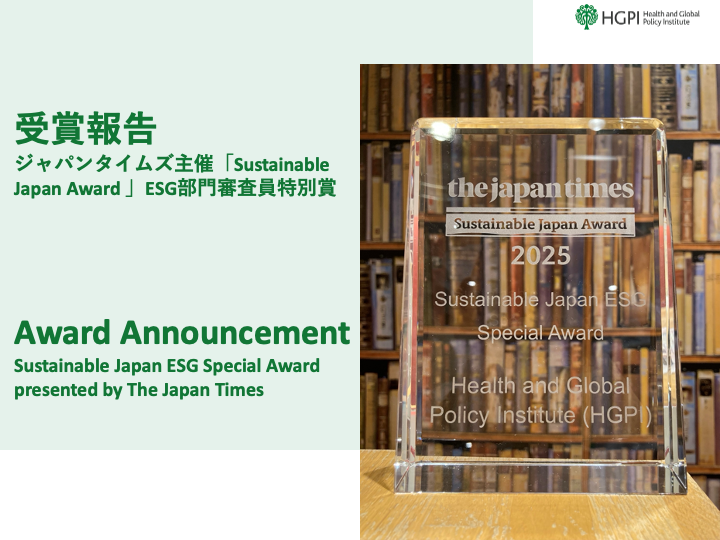
2025-10-15
[Award Report] Sustainable Japan Award 2025 (ESG Category) (The Japan Times, September 18, 2025)
-
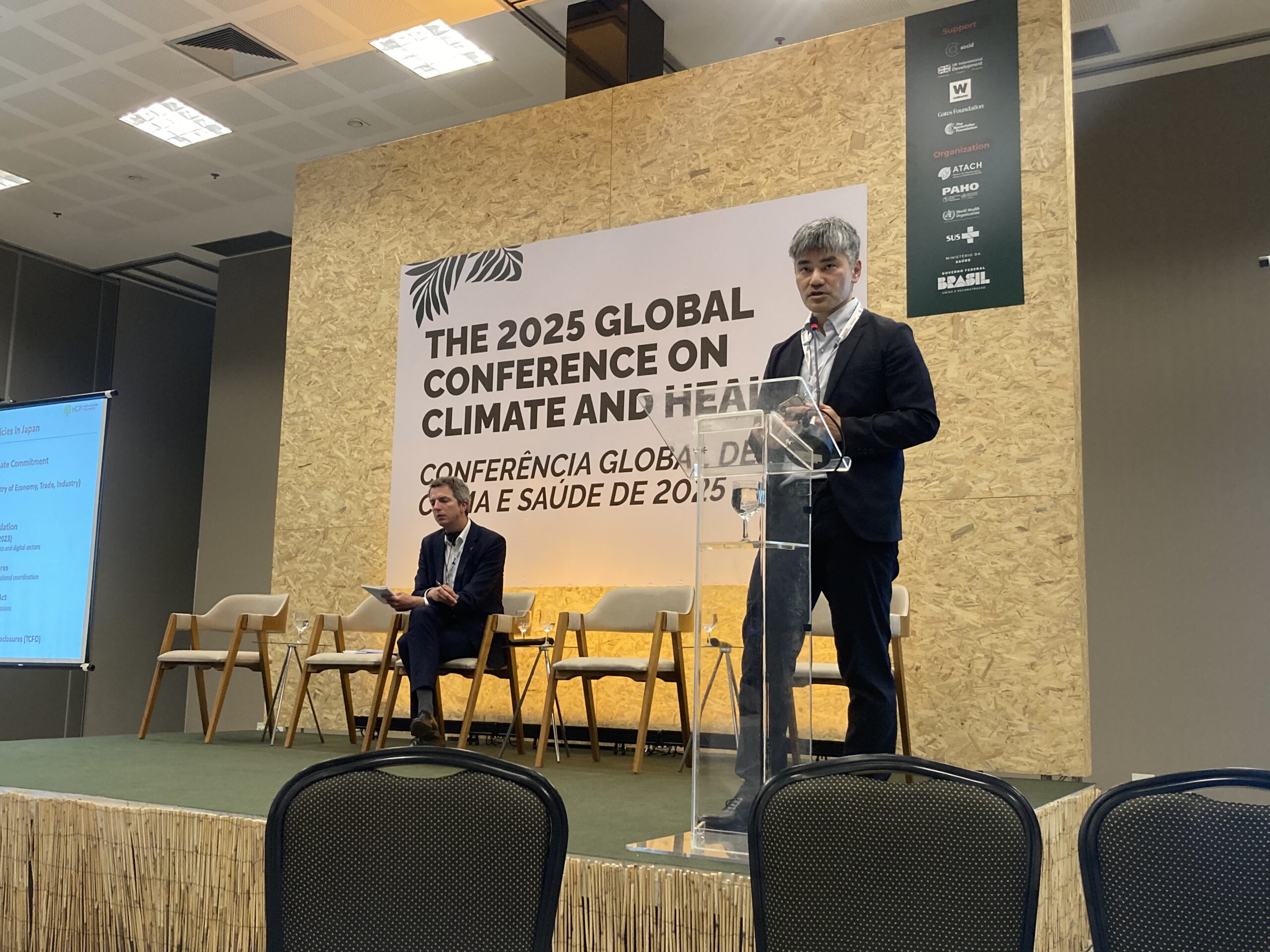
2025-08-15
[Lecture Report] 2025 Global Conference on Climate and Health (July 31, 2025, Brasília, Brazil)
-
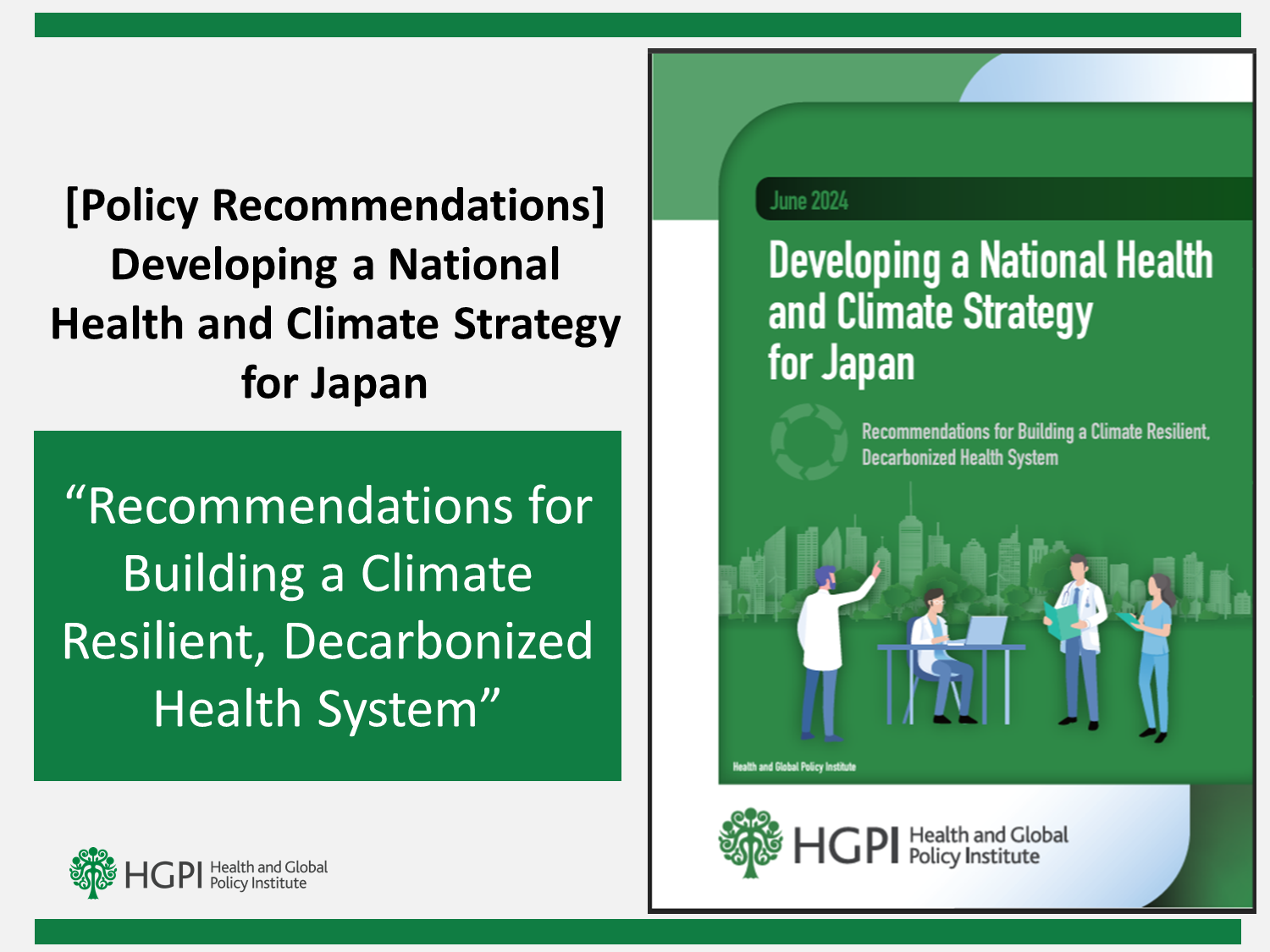
2024-06-26
[Policy Recommendations] Developing a National Health and Climate Strategy for Japan (June 26, 2024)
-
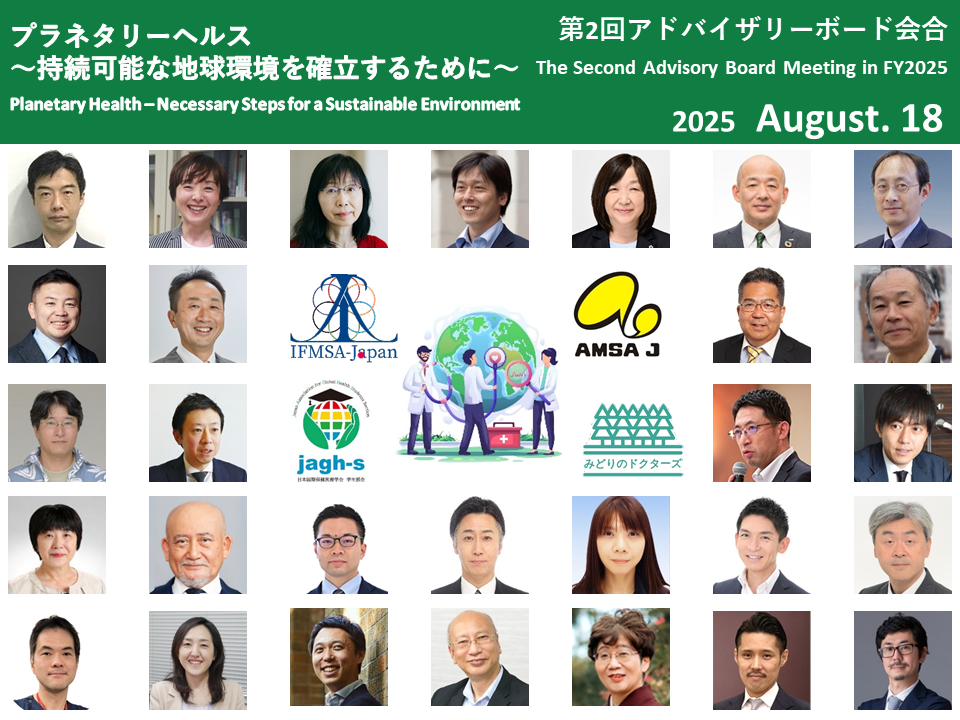
2025-08-31
[Event Report] Planetary Health Project: Second Advisory Board Meeting of FY2025 (August 18, 2025)
Top Research & Recommendations Posts
- [Policy Recommendations] The Path to a Sustainable Healthcare System: Three Key Objectives for Public Deliberation (January 22, 2026)
- [Research Report] Perceptions, Knowledge, Actions and Perspectives of Healthcare Organizations in Japan in Relation to Climate Change and Health: A Cross-Sectional Study (November 13, 2025)
- [Research Report] The 2025 Public Opinion Survey on Healthcare in Japan (March 17, 2025)
- [Policy Recommendations] Reshaping Japan’s Immunization Policy for Life Course Coverage and Vaccine Equity: Challenges and Prospects for an Era of Prevention and Health Promotion (April 25, 2025)
- [Research Report] The 2023 Public Opinion Survey on Satisfaction in Healthcare in Japan and Healthcare Applications of Generative AI (January 11, 2024)
- [Research Report] AMR Policy Update #4: Cancer Care and AMR (Part 1)
- [Public Comment Submission] “Assessment Report on Climate Change Impacts in Japan (Draft Overview)” (December 24, 2025)
- [Policy Recommendations] Developing a National Health and Climate Strategy for Japan (June 26, 2024)
- [Research Report] The 2026 Public Opinion Survey on Healthcare in Japan (February 13, 2026)
- [Research Report] The Public Opinion Survey on Child-Rearing in Modern Japan (Final Report) (March 4, 2022)
Featured Posts
-
2026-01-09
[Registration Open] (Hybrid Format) Dementia Project FY2025 Initiative Concluding Symposium “The Future of Dementia Policy Surrounding Families and Others Who Care for People with Dementia” (March 9, 2026)
![[Registration Open] (Hybrid Format) Dementia Project FY2025 Initiative Concluding Symposium “The Future of Dementia Policy Surrounding Families and Others Who Care for People with Dementia” (March 9, 2026)](https://hgpi.org/en/wp-content/uploads/sites/2/dementia-20260309-top.png)
-
2026-02-05
[Registration Open] (Webinar) The 141st HGPI Seminar “Current Status and Future Prospects of Korea’s Obesity Policy: Voices of People with Lived Experience in Policy Promotion” (March 3, 2026)
![[Registration Open] (Webinar) The 141st HGPI Seminar “Current Status and Future Prospects of Korea’s Obesity Policy: Voices of People with Lived Experience in Policy Promotion” (March 3, 2026)](https://hgpi.org/en/wp-content/uploads/sites/2/hs141-top-1.png)
